
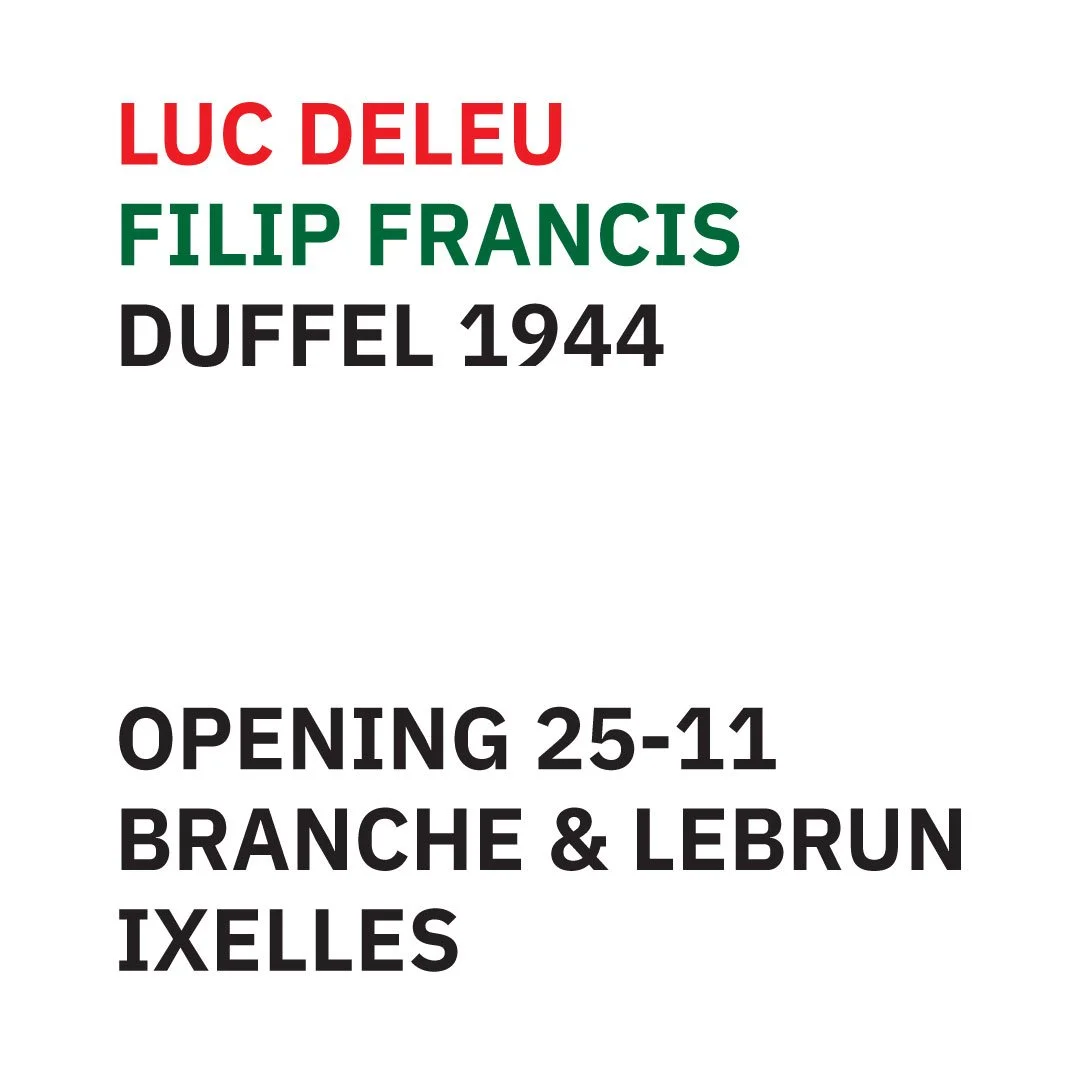
DUFFEL 1944 - LUC DELEU X FILIP FRANCIS
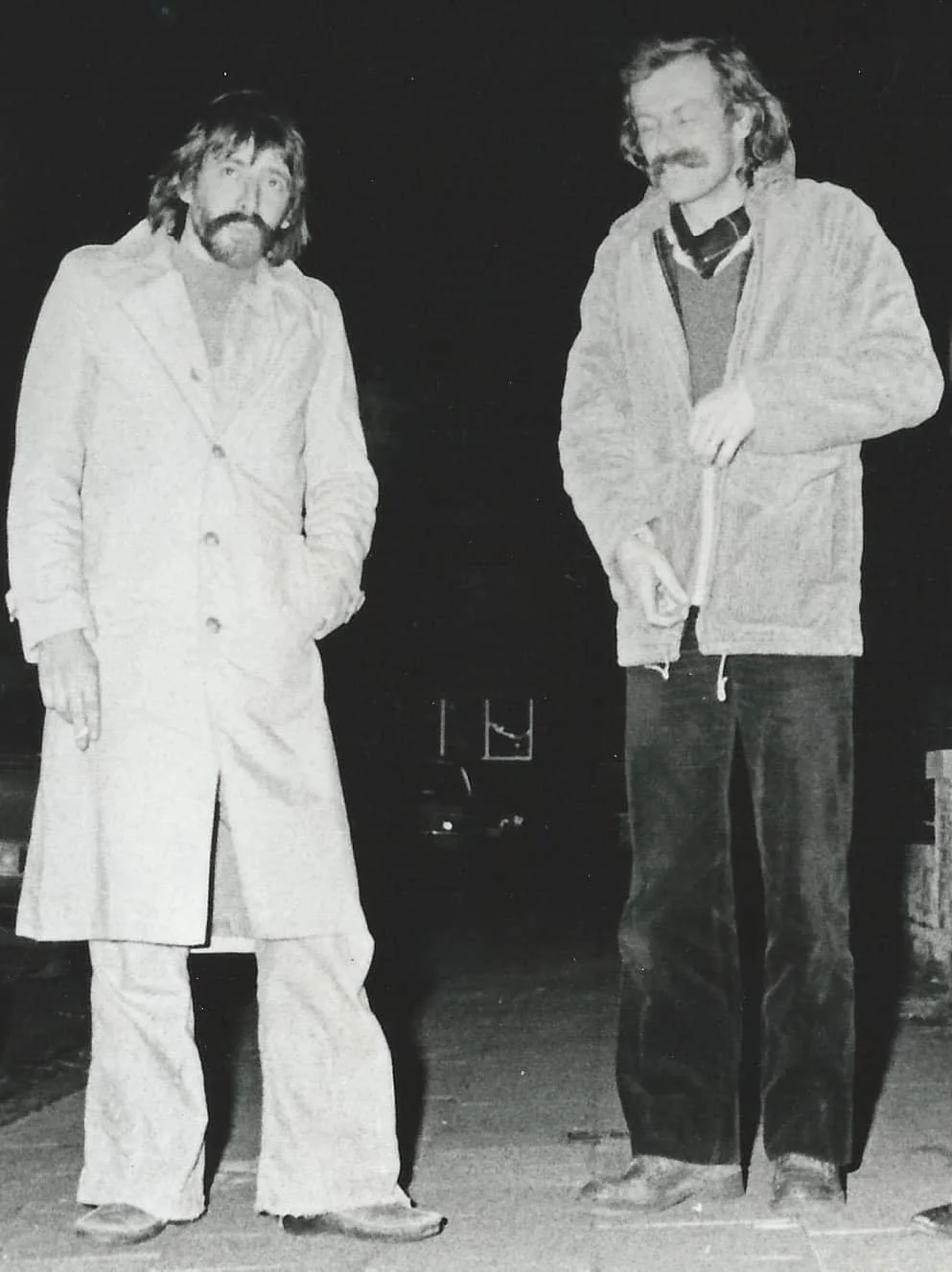
This exhibition marks a first. For the very first time, the works of Luc Deleu (Duffel, 1944) and Filip Francis (Duffel, 1944–2023) are being exhibited together. And that is quite surprising. Not only were Deleu and Francis born in the same year, but they were also born and raised in Duffel, a rural town on the River Nete, between Antwerp, Mechelen and Lier.
They shared classrooms and formed a friendship in kindergarten and primary school, before both moving to Brussels to study at Sint-Lukas. Deleu chose architecture, while Francis opted for painting. Two collaborations date from their student years, both of which are represented in this exhibition: the model for a cultural centre (1967) and the collage book Norman Normal. Infrastructural Layout for Antwerp (1968–1969).
After completing their studies, both moved to Antwerp, where they made their debut in 1970 at Vacuum (voor nieuwe dimensies), an exhibition space run by Filip Francis and his then wife, Maryse Masson. Vacuum occupied the ground floor of their stately Art Nouveau house, De Waterlelies, on Cogels-Osylei, which they shared with Luc Deleu and Laurette Gillemot.
Between January 1970 and March 1971, they organised fourteen exhibitions there. These generally featured projects by young artists from their circle or international friends looking for a place to stay or exhibit. An eclectic community of artists, students, collectors, musicians, filmmakers, hipsters and curious visitors soon found its way to this alternative space.
On 6 February 1970, Luc Deleu caused a stir in the world of architecture and urban planning with ‘Luc Deleu neemt afscheid van architectuur’ (“Luc Deleu Says Goodbye to Architecture”). He presented his third-year project, Kerk in de duinen (“Church in the Dunes”, 1968), alongside his graduation project, Europakruispunt (Brussel) (“European Crossroads, Brussels”, 1969). For the occasion, he covered the exhibition space's parquet floor with white sand. On the walls, he displayed drawings and collages of a distinctly polemical nature, sparing none of the icons of modernism. It is no coincidence that T.O.P. office was founded that same year. This experimental design practice, which Deleu continues to run with Laurette Gillemot to this day, is housed in the former Vacuum exhibition space.
One month later, on 15 March, Francis opened his exhibition Ultra. He presented designs and results from his spatial and temporal research, based on the principles of “ultra-structures” and “ultra-communication”. One of these designs is also included in the present exhibition: Ultra-Communicatie Machine (1970–1971), a device in which two people could identify with one another visually and mentally in order to achieve optimal contact. The two historic Vacuum exhibition posters, screen-printed with “Maf Print” George Smits of the Ercola collective, are also on display.
Just as his close friend formally took leave of “architecture”, Francis explicitly distanced himself from conventional painting and sculpture. His earlier participation in happenings in Brussels, together with experiments in film and other new media, led him towards explorations of the relationships between time and space. In doing so, he readily ventured beyond the boundaries of established artistic expectations.
Both Deleu and Francis challenged prevailing ideas about art and society, launching provocative projects and proposals designed to question accepted conventions.
One such initiative was the travelling T.O.P. office Multi Mixed Media Show, alongside the Gratis Kunst (“Free Art”) action of December 1970. In collaboration with the Contemporary Art Department of the Royal Museum, participants were sought who would receive a work of art in exchange for carrying out a task assigned by the artists.
Following the closure of Vacuum, Deleu and Francis continued collaborating with Hugo Heyrman on the screen-printed magazine Artworker Star (1971–1972) and the Continentale Video- en Filmtoer (1973), a mobile cinema housed in a converted demonstration bus and featuring a programme of experimental films.
Gradually, these brothers in art devoted more attention to their individual projects, but they remained in contact, even after Francis moved to Brussels. Alongside their artistic practices, both also took up teaching positions at their alma mater, Sint-Lukas. For Luc Deleu, this meant continuing to develop local and international proposals, projects, plans and realised works through T.O.P. office. The exhibition includes several examples, both historical and more recent. These works demonstrate how Deleu and T.O.P. office challenge established frameworks of research and reference. Their conceptual approach to architectural, urban and ecological issues leads to a radical methodology described as “orbanism”. Operating at the intersection of architecture, urban planning and visual art, Deleu has created, through T.O.P. office, a “free space” that allows him and others to think and act more freely, with the ultimate aim of expanding freedom within society.
Filip Francis, meanwhile, continued to deepen his explorations of time and space, notably through a series of paintings entitled Een oneindige beperking (“An Infinite Limitation”, 1973). These feature the repeatedly inscribed phrase “space/time = time/space”, written in progressively smaller lettering over nine days and nights of continuous writing. Film also became an increasingly important part of his practice, as did performance, particularly through installations in which the relationship between time and space was made tangible and audible, as in Climax for Tumbling Woodblocks (1975).
Like his fellow artist, Francis consistently sought to push boundaries: those of artistic media, as well as those of feasibility and physical endurance. This approach is evident, for example, in his paintings featuring the endlessly repeated word “etcetera”, one of which is included in the exhibition. From the late 1970s onwards, this exploratory way of thinking and working led Francis back to painting, although he continued to question the medium at its most fundamental level. In his experiments with peripheral vision during the 1980s and 1990s, he investigated — quite literally — the limits of painting. Chance, time, space, perception and the artist's role as an active participant among these factors form a recurring thread — both red and green — throughout these pictorial experiments.
Luc Deleu's decision to present the work of his friend and fellow artist Filip Francis alongside his own reflects the affinities he recognises between their respective practices.
He himself describes these shared qualities as “multi-layered, conceptual, performative, allowing a chance to enter the design process and, last but not least, a sense of humour”.
Johan Pas
Opening · Wednesday, 25 November 2026 at 5 pm
Closing event · Saturday, 9 January 2027
Venue · Branche & Lebrun, 69 Rue Alphonse Renard, 1050 Ixelles
Press contact : Dries Tack · dries@branchelebrun.com · +32 498 91 80 54